Introduction
If you have typed “Mary Nightingale illness” into a search engine recently, you are not alone. Thousands of viewers across the United Kingdom share the same concern, searching for answers about one of Britain’s most trusted and longest-serving news presenters.
Mary Nightingale has anchored the ITV Evening News since 2001, making her a familiar and reassuring presence in millions of British homes. Her calm authority, precise delivery, and ability to guide viewers through some of the most significant national and global events of the past two decades have earned her exceptional respect. So when rumours about her health began circulating online, it naturally sparked widespread public concern.
This article addresses those rumours directly, clearly, and honestly. It separates verified fact from unconfirmed speculation, explores the origins of the health conversation, and provides a detailed look at Mary Nightingale’s remarkable career, achievements, and continued role at ITV News. If you want the truth about Mary Nightingale’s health, you will find it here.
Who Is Mary Nightingale? A Brief Look at Her Career and Legacy
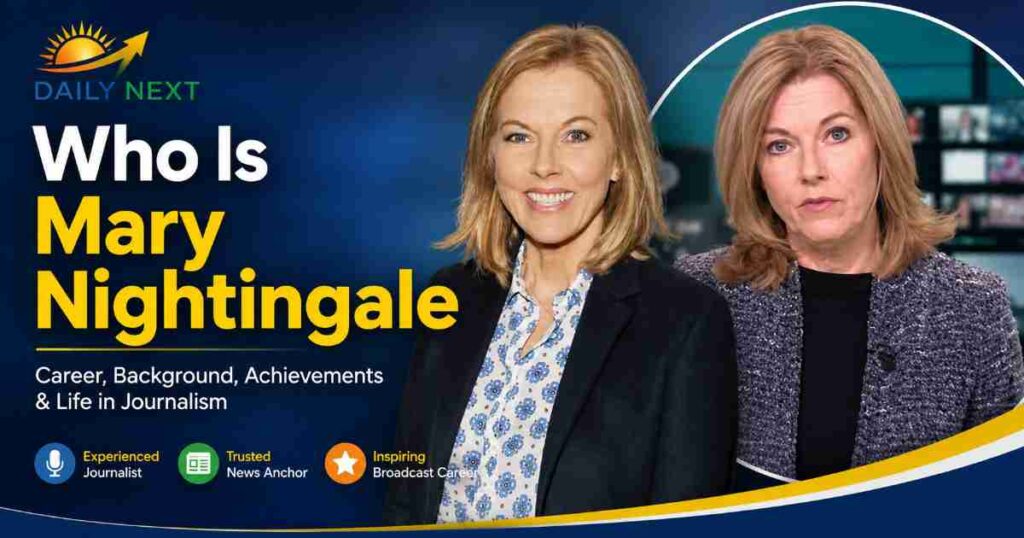
Mary Nightingale was born in Scarborough, North Yorkshire, in 1963. Before she became one of the most recognisable faces in British television news, she built her skills across a wide range of broadcasting and journalism roles that gave her a particularly strong foundation in economic and financial reporting.
Her career began in earnest at TV Tokyo, where she worked as a presenter and writer on the World Business Satellite programme. She then moved to the BBC World Service Television, presenting and writing for the World Business Report and covering economic and corporate stories for international audiences. In 1994, she joined Reuters Financial Television as a presenter on its early morning financial programme, and in 1995 she worked for ITN presenting weekend editions of their World News service.
During the mid-to-late 1990s, she broadened her portfolio significantly. She presented the Holiday Programme on BBC1, co-presented Carlton Country, and anchored ITV’s flagship holiday series Wish You Were Here from 1999 to 2001. She also covered the 1996 World Skiing Championships for BBC Two’s Ski Sunday, demonstrating an impressive versatility that went well beyond the newsroom.
The defining moment in her career came in 2001 when she became the lead anchor of ITV Evening News. That role transformed her into a household name almost immediately. She covered Queen Elizabeth II’s funeral, the 2011 Royal Wedding, general elections, global conflicts, and countless other events that shaped the nation’s understanding of the world around it.
Read More: Judith McKerrecher: Modern Languages Leader in Scotland’s Education
Key Career Milestones at a Glance
| Year | Milestone |
| Early 1990s | Presenter at TV Tokyo and BBC World Service Television |
| 1994 | Presenter at Reuters Financial Television |
| 1995 | Weekend News presenter at ITN |
| 1999–2001 | Hosted Wish You Were Here on ITV |
| 2001 | Became lead anchor of ITV Evening News |
| 2002 and 2004 | Won TRIC Newscaster of the Year Award |
| 2011 | Covered the Royal Wedding live |
| 2017 | Became sole presenter of ITV Evening News |
| 2023 | Appointed Officer of the Order of the British Empire (OBE) |
In January 2017, it was announced that she would become the sole presenter of the ITV Evening News, cementing her position at the very top of British broadcast journalism. Her consistency in this role, spanning more than two decades without interruption, is itself a remarkable professional achievement.
What Sparked the Mary Nightingale Illness Rumours?
Understanding where these rumours came from is essential to evaluating them fairly. The truth is that no single dramatic health event sparked the online conversation. Instead, a combination of factors created a growing wave of speculation that spread rapidly across social media.
Viewer Observations About Her Voice
One of the most frequently cited reasons for concern involves perceived changes in her vocal quality during live broadcasts. Some viewers noticed what they described as hoarseness, occasional vocal fatigue, or slight variations in her delivery. Broadcasting for extended periods, several nights a week, across many years places significant demands on anyone’s voice. Vocal strain, minor throat infections, and seasonal conditions can all affect a presenter’s delivery without signalling anything serious.
Confusion With Other ITV Presenters
In 2024, fellow ITV journalist Rageh Omaar suffered a medical episode live on air, which drew enormous attention across social media and news platforms. Some viewers, perhaps unfamiliar with the difference between presenters, incorrectly linked this incident to Mary Nightingale. Once that confusion spread online, it became another thread in the broader narrative around her health.
The 2024 Deepfake Crisis
Perhaps the most significant accelerant of health speculation was a deeply troubling AI-generated video that emerged in early 2024. A fabricated video showed Mary Nightingale appearing to sit at the ITV news desk promoting a fraudulent investment scheme. Mary herself publicly condemned the video, describing it as identity theft. This incident not only raised serious questions about AI misuse but also put her name and face into widespread circulation in a misleading context, fuelling further confusion and rumour online.
The Speed of Social Media
As with many public figures, a single comment or post suggesting that a presenter “doesn’t look well” or “sounds different” can spiral into a widespread narrative within hours. Digital platforms amplify unverified claims faster than fact-checking can address them. The absence of an official denial sometimes reads to audiences as confirmation, when in reality it simply reflects a public figure’s entirely reasonable choice not to comment on baseless speculation.
Mary Nightingale’s Response to the Illness Rumours
Mary Nightingale has not issued any formal statement specifically addressing the health rumours in their entirety, which in itself is telling. Public figures who have experienced genuine serious illness typically choose to disclose it on their own terms and through appropriate channels. The absence of any such disclosure from Mary, or from ITV News as her employer, is a strong indicator that there is no serious confirmed health condition to report.
What she has spoken about publicly is the deepfake video that misused her image in 2024. Her clear and direct condemnation of that video demonstrated both her awareness of the misinformation problem and her commitment to setting the record straight where she had the standing and information to do so.
She has continued to appear regularly on ITV Evening News, conducting interviews, presenting breaking news coverage, and fronting major broadcasts. Her continued, consistent, and uninterrupted professional presence is the most meaningful indicator of her well-being available to the public.
The Importance of Privacy in a Journalist’s Life
It is worth pausing to consider why public figures, including journalists, are entitled to privacy regarding their health. The fact that someone appears on television does not give audiences an automatic right to information about their medical history or current health status.
Mary Nightingale has consistently maintained a clear boundary between her public professional life and her private personal life. She is married to television producer Paul Fenwick, with whom she has two children. They live in Hammersmith in west London. Beyond these broad outlines, she has deliberately chosen not to share detailed personal information, and that choice deserves respect.
In British journalism, health updates about well-known broadcasters are shared through official channels when necessary, and only when the individual chooses to disclose them. There has been no such official communication about Mary Nightingale’s health. That absence is meaningful, and responsible audiences should interpret it accordingly.
There is a broader point here too. Speculating about someone’s illness based on how they sound during a late-night news bulletin, or because another presenter had a health scare, or because a fabricated AI video misused their image, is not a responsible or fair way to treat anyone, regardless of how famous they are.
Mary Nightingale’s Career Achievements and Recognition
One of the clearest measures of Mary Nightingale’s professional standing is the recognition she has received from her industry peers and from the British honours system.
TRIC Newscaster of the Year
Mary won the Television and Radio Industries Club (TRIC) Award for Newscaster of the Year in both 2002 and 2004. These awards are voted on by broadcasting professionals, including journalists, producers, and media industry leaders. Winning this award twice, in the early years of her ITV Evening News role, confirmed what audiences were already experiencing: that she was genuinely among the finest broadcast journalists of her generation.
BAFTA Recognition
Her coverage of the Queen Mother’s death earned her a BAFTA nomination, further underlining the quality and impact of her work during major national moments. BAFTA nominations are granted by peers within the creative and broadcasting industries, and receiving one for live news coverage reflects exceptional professional skill.
OBE for Services to Journalism
In 2023, Mary Nightingale was appointed an Officer of the Order of the British Empire (OBE) for her services to journalism and broadcasting. This is one of the most significant formal honours available in the United Kingdom and reflects the kind of sustained, meaningful contribution to public life that goes well beyond ratings or visibility. It is an acknowledgement of decades of reliable, trustworthy, and high-quality public service broadcasting.
Other Notable Programmes and Contributions
Beyond the evening news, Mary has presented a wide range of other programmes. These include Britain’s Best Dish, Holiday Undercover, The Girl Who Would Be Queen (an intimate ITV portrait of Queen Elizabeth II on her 80th birthday), and the crime series Reward, which examined unsolved cases with outstanding financial rewards. This breadth of work shows a journalist and presenter who has never been content to simply read headlines but has consistently sought out meaningful, substantial stories across formats and genres.
Public Reactions and Support for Mary Nightingale
The public response to the rumours about Mary Nightingale’s health has been largely sympathetic and supportive. Viewers who have watched her for twenty-plus years have expressed genuine concern, but the dominant tone from her audience has been one of warmth, loyalty, and trust.
Many regular viewers have taken to social media to defend her against speculation, pointing out her continued strong on-screen presence and pushing back against unverified claims. The affection that audiences feel for her is a product of decades of reliable, calm, and authoritative news delivery during some of Britain’s most challenging moments.
This kind of public loyalty is not simply about familiarity. It reflects genuine trust. When viewers see Mary Nightingale behind the ITV news desk, they associate her presence with credibility and stability. That association has been built slowly and consistently over more than two decades of professional integrity.
Clarifying the Truth About Mary Nightingale’s Health
Given all the available evidence, here is a clear, honest summary of what is actually known about Mary Nightingale’s health.
What is confirmed:
- Mary Nightingale continues to present the ITV Evening News as of 2026.
- There is no official statement from Mary Nightingale, ITV News, or her management confirming any serious illness.
- No credible or authoritative news organisation has reported any confirmed serious health condition.
- She continues to appear in journalism, interviews, and live broadcasts.
What is unconfirmed speculation:
- Claims about cancer or chronic illness circulating on social media.
- Suggestions that voice changes indicate serious disease.
- Any health narrative linked to the 2024 deepfake video incident.
- Assumptions drawn from brief absences or perceived appearance changes.
What is important context:
- Voice variations in a broadcaster with decades of experience can result from entirely routine and temporary conditions including vocal strain, mild respiratory infections, or seasonal allergies.
- Brief absences from presenting are normal across any long career and do not indicate illness.
- The deepfake video that spread in 2024 was confirmed as fabricated and had no connection to any health issue.
Health Rumour vs. Confirmed Fact: A Summary Table
| Claim | Status |
| Mary Nightingale has cancer | No credible confirmation |
| She is no longer working at ITV | False: she continues as Evening News presenter |
| The deepfake video showed a real health crisis | False: video was confirmed AI-generated fraud |
| Rageh Omaar’s health incident was linked to Mary | False: separate, unrelated incident |
| Voice changes indicate serious illness | Unsubstantiated: vocal strain is common in broadcasting |
| She received an OBE in 2023 | Confirmed and verified |
| She won TRIC Newscaster of the Year | Confirmed in 2002 and 2004 |
Mary Nightingale’s Ongoing Role and Future Endeavors
As of 2026, Mary Nightingale remains an active and central figure at ITV News. ITV’s official presenter pages continue to list her as the Evening News anchor, and recent ITV output shows her fronting major interviews, breaking news coverage, and significant broadcast moments.
Her career trajectory suggests someone who has absolutely no intention of stepping back. She joined ITV News in 2001 and has spent 25 years building a reputation that is as strong today as it has ever been. The OBE she received in 2023 came at a point in her career when most observers might consider a period of recognition and reflection, but her continued active presence suggests she remains committed to the craft and the role that has defined her professional life.
She also maintains a social media presence, primarily on X (formerly Twitter), where she shares professional updates and occasionally personal reflections. While she is clearly not a personality-first presence on these platforms, her online engagement allows viewers a small window into her perspective beyond the news desk.
Looking forward, her continued role at ITV is perhaps the clearest indicator of her professional and personal stability. Networks do not retain long-serving anchors out of sentiment alone. Mary Nightingale remains at the desk because she is still one of the best at what she does.
Lessons Learned from the Mary Nightingale Illness Rumours
The conversation around Mary Nightingale’s health offers some important lessons for all of us who consume news and information online.
1. Verify Before You Share
Unverified claims spread at enormous speed on social media. Before sharing a post about a public figure’s health, it is worth asking: where did this information come from? Is it from a credible, named source? Has the person or their employer confirmed it? If the answer to these questions is no, the responsible choice is to pause before amplifying the claim.
2. Context Matters Enormously
A change in a presenter’s voice during a late broadcast could mean dozens of entirely mundane things: a cold, a long day, seasonal allergies, or simply the natural variation that exists in any human voice. Drawing sweeping conclusions from a single observation is not fair to the individual or accurate to the facts.
3. Deepfakes Are a Real and Growing Threat
The 2024 incident involving a fabricated video of Mary Nightingale is a vivid reminder of the dangers of AI-generated content used maliciously. As deepfake technology becomes more sophisticated and accessible, the risk of public figures being misrepresented in convincing ways increases. Critical media literacy is more important now than it has ever been.
4. Public Figures Deserve Privacy
Fame does not eliminate the right to privacy. Mary Nightingale’s health is her own business, and any decision about whether and when to disclose health information belongs entirely to her. Audiences who respect that boundary demonstrate a maturity of engagement that public discourse increasingly needs.
5. Absence Is Not Confirmation
When a public figure does not issue a denial of a specific rumour, that silence is not confirmation of the rumour. It may simply reflect a considered decision not to dignify speculation with a formal response. This is a perfectly reasonable position for any professional to take.
Conclusion
The truth about Mary Nightingale’s health is straightforward. As of 2026, there is no confirmed or credible evidence of any serious illness. She continues to anchor ITV Evening News, appears in regular broadcasts, and remains one of the most recognised and respected journalists in British television.
The rumours that have circulated online draw on a combination of viewer observations about vocal changes, confusion with other presenters’ health incidents, and the deeply troubling AI deepfake video that misused her image in 2024. None of these amount to evidence of illness. They are the product of an information environment in which speculation spreads faster than fact-checking.
Mary Nightingale has spent more than 25 years delivering news with calm authority, integrity, and consistency. She has won industry awards voted on by her broadcasting peers, received a BAFTA nomination, and been honoured by the British state with an OBE for her services to journalism. She became the sole presenter of ITV Evening News in 2017 and has remained in that role.
The best way to understand Mary Nightingale’s health and wellbeing is to watch the ITV Evening News. She is there, as she has been for over two decades, doing the work she does better than almost anyone else.
FAQs
Does Mary Nightingale have a confirmed illness?
No. There is no official statement from Mary Nightingale, ITV News, or any credible source confirming a serious illness. All claims circulating online are unverified speculation.
Is Mary Nightingale still presenting on ITV?
Yes. As of 2026, she continues to anchor the ITV Evening News and remains one of the network’s core presenting team.
Why do people think Mary Nightingale is ill?
Rumours stem from a combination of minor voice changes observed by viewers, confusion with a separate health incident involving another ITV presenter in 2024, and the widely shared deepfake video that misused her image.
What was the Mary Nightingale deepfake video?
In 2024, an AI-generated video falsely showed Mary appearing to promote a fraudulent investment scheme. She confirmed it was fake and publicly condemned it as identity theft. It had no connection to any illness.
Has Mary Nightingale won any awards?
Yes. She won the TRIC Newscaster of the Year award in 2002 and 2004, received a BAFTA nomination for her coverage of the Queen Mother’s death, and was appointed an OBE in 2023.
How long has Mary Nightingale been at ITV News?
She has been with ITV News since 2001, making her one of the longest-serving anchors of a single network news programme in British broadcasting history.
What is Mary Nightingale’s background before ITV?
She worked at TV Tokyo, BBC World Service Television, Reuters Financial Television, and ITN before joining ITV, with a strong foundation in economic and financial reporting.
Is Mary Nightingale married?
Yes. She has been married to television producer Paul Fenwick since April 2000. They have two children and live in Hammersmith, west London.
Did another ITV presenter’s illness get confused with Mary Nightingale?
Yes. ITV journalist Rageh Omaar experienced a medical episode live on air in 2024, and some viewers incorrectly linked this to Mary Nightingale. The two incidents are completely separate and unrelated.
What should I do if I see health rumours about Mary Nightingale online?
Apply the same standard you would to any claim: check whether it comes from a named, credible source, whether ITV or Mary has confirmed it, and whether it is reported by a reputable news organisation. If not, treat it as unverified.