
Introduction
When you think about educators who genuinely change lives, Judith McKerrecher is exactly the kind of person who comes to mind. A passionate, forward-thinking language educator based in Edinburgh, Scotland, she has spent more than two decades building something rare in any school system: a modern languages department where curiosity thrives, cultures connect, and students genuinely want to learn.
Her name carries weight in Scottish education circles, and for good reason. As Curriculum Leader for Modern Languages and International Education at Craigmount High School, Judith has shaped the way hundreds of students experience French, German, Spanish, and Mandarin. She has contributed to national language policy, supported teacher development across Scotland, and championed cross-cultural learning at a time when global citizenship matters more than ever.
This article takes a close look at Judith McKerrecher’s journey, from her earliest academic steps through to her current work as both an educator and a celebrant, unpacking what makes her an outstanding figure in Scotland’s modern languages landscape.
Judith McKerrecher Early Life and Academic Background
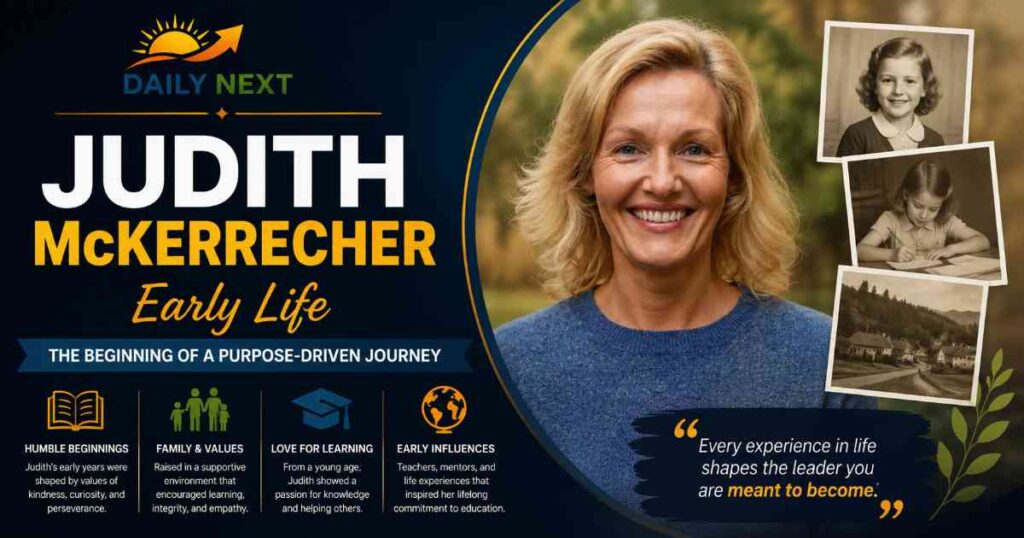
Every great educator has a story that begins long before they ever stand in front of a class. For Judith McKerrecher, that story starts with a genuine love of language that grew steadily through childhood and into higher education.
She pursued a Joint Honours degree in French and German at Newcastle University, a rigorous academic programme that sharpened both her linguistic ability and her understanding of European culture. She did not stop there. Judith deepened her studies through time spent at the University of Tübingen in Germany and at the Université Grenoble Alpes in France. These experiences abroad were formative, giving her a lived understanding of intercultural communication that would later define her teaching philosophy.
After returning to Scotland, she completed a Postgraduate Certificate in Education (PGCE) with a focus on modern languages, equipping her with the practical tools needed to inspire young learners. Her academic foundation was not just solid; it was expansive. It gave her the confidence to teach across multiple languages, and eventually to branch into Mandarin, a language less commonly offered in Scottish secondary schools at the time.
Key Academic Milestones
| Qualification | Institution | Focus Area |
| Joint Honours (French & German) | Newcastle University | Linguistics and European Culture |
| Study Abroad Programme | University of Tübingen | German Language and Culture |
| Study Abroad Programme | Université Grenoble Alpes | French Language and Cultural Immersion |
| PGCE in Modern Languages | Scottish Teacher Training | Curriculum and Pedagogy |
This blend of academic rigour and real-world immersion gave Judith something that no single textbook could provide: an authentic voice as a language professional.
Read More: Hamish Badenoch Eton: Education, Career, Family & Biography Revealed
Teaching Career Beginnings: From Classroom to Leadership
Judith McKerrecher’s teaching career began at Liberton High School in Edinburgh, where she brought energy, creativity, and a genuine commitment to inclusive learning into her classroom every day. Her early lessons were marked by a focus on student engagement, using collaborative techniques and culturally relevant materials to make French, German, and Spanish feel less like academic subjects and more like living tools for communication.
It was during this period that she began introducing Mandarin and Spanish taster sessions in associated primary schools, a forward-thinking move at a time when many secondary schools were still focused narrowly on European languages. These taster programmes planted early seeds of curiosity in younger learners and reflected Judith’s belief that language learning should start early and feel exciting rather than obligatory.
Her classroom reputation grew steadily. Colleagues noticed her ability to build trust with students across all ability levels, and school leaders recognised her talent for curriculum thinking. She was not simply delivering lessons; she was shaping learning experiences with intention.
What Set Her Apart Early On
- A learner-centred approach that prioritised student voice and participation
- Creative use of cultural materials, music, film, and authentic texts in lessons
- Early adoption of digital tools to support language acquisition
- Willingness to introduce less common languages like Mandarin into primary feeder schools
- A collaborative leadership style that brought colleagues along rather than working in isolation
These qualities did not go unnoticed, and they laid the groundwork for the leadership roles that followed.
Leadership in Modern Languages Education
Since 2013, Judith McKerrecher has served as Curriculum Leader for Modern Languages at Craigmount High School in Edinburgh. In this role, she oversees the full scope of the department: curriculum design, timetabling, resource management, staff development, and student progress across all year groups and qualifications.
Her leadership philosophy is grounded in three core principles: equity, collaboration, and lifelong learning. She believes firmly that every student, regardless of socio-economic background or prior attainment, deserves access to high-quality language education. This belief has driven her to design inclusive programmes that stretch the most able learners while supporting those who find languages challenging.
Curriculum Contributions at Craigmount High School
Under her leadership, the modern languages curriculum at Craigmount expanded to include a wider range of opportunities for students to engage with language learning in authentic, meaningful ways. This included:
- Broadening the languages on offer to include Mandarin Chinese alongside French, German, and Spanish
- Embedding intercultural competence into day-to-day language lessons
- Developing co-operative learning frameworks that encourage peer support
- Integrating restorative practices into classroom management
- Building independent learning pathways through metacognitive skill development
- Supporting students in gaining external qualifications such as the Languages for Life and Work Award in Mandarin
Beyond her own school, Judith contributed to Scotland’s national 1+2 Languages policy, which encourages all young people to learn a first additional language from Primary 1 and a second additional language from Primary 5. Her involvement in the working group for this policy reflects her commitment to shaping language education at a systemic level, not just within her own four walls.
She was also recognised nationally with the Convener’s Award for Outstanding Achievement from Edinburgh Council’s Children and Families Department, a significant acknowledgement of her contribution to transforming language education across the city.
Championing Mandarin and Chinese Cultural Exchange
One of the most distinctive threads running through Judith McKerrecher’s career is her commitment to Mandarin education and Chinese cultural exchange, at a time when this was genuinely pioneering in Scottish schools.
She went on secondment as Professional Development Officer for the Confucius Institute for Scotland’s Schools, a role that extended her influence far beyond Craigmount. In this capacity, she supported Chinese language and culture teaching in both primary and secondary schools across Scotland. She worked directly with Confucius Classroom Hubs, developed and delivered professional learning for teachers, and provided mentoring and guidance for Tianjin teachers who came to Scotland as part of cultural exchange programmes.
Perhaps most impressively, she served as Acting Head Teacher at the Edinburgh Community Chinese School on a voluntary basis. In that role, she introduced the Curriculum for Excellence profiling system, managed examination presentations, and provided teacher training, all while holding down her full-time position at Craigmount.
Why Mandarin Matters in Scottish Education
Mandarin Chinese is the most spoken language in the world by native speakers. As Scotland’s trade, cultural, and academic links with China have grown, the ability of young people to communicate in Mandarin has become an increasingly valuable life skill. Judith understood this long before it became mainstream, and she acted on that understanding.
Her involvement with the Scottish Parliament Cross-China Group and the Scotland-China Education Network (SCEN) further cemented her standing as a key bridge between Scottish education and Chinese culture. She has visited China personally, collaborating with schools there and exploring exchange opportunities that enriched learning for students on both sides.
The Mandarin Study Club she established at Craigmount offered students a space to pursue Chinese language learning outside formal timetabled lessons, a commitment to providing opportunity that went well beyond contractual obligations.
Community Engagement and Beyond the School Gate
A recurring theme in Judith McKerrecher’s career is the way her dedication extends far beyond any job description. Whether working with vulnerable children during the COVID-19 pandemic or volunteering her time at community education programmes, she has consistently shown that her commitment to learners does not switch off when the school bell rings.
During the pandemic, while many aspects of Scottish education ground to a halt, Judith worked in a school hub supporting vulnerable children and the children of key workers. This quiet act of service spoke volumes about her character and her understanding of the pastoral dimension of teaching.
Her work with the Edinburgh Community Chinese School is another example. Volunteering as Acting Head Teacher is a significant undertaking for anyone, let alone someone managing a busy secondary school department at the same time. Yet she took it on because she believed in the value of what the school was doing for Edinburgh’s Chinese community.
Community Contributions at a Glance
- Volunteered as Acting Head Teacher at Edinburgh Community Chinese School
- Supported Confucius Classroom Hubs across Scotland
- Mentored international teachers new to the Scottish education system
- Worked in a school hub during COVID-19 to support vulnerable children and families
- Participated in cross-cultural education networks at national level
This breadth of community involvement shows a person who sees education not just as a professional role but as a civic responsibility.
New Pathways: Celebrant, Lifelong Learning and Future Vision
In a career already marked by continuous evolution and reinvention, Judith McKerrecher has more recently added another dimension to her professional life: that of a celebrant. In this role, she officiates at weddings, funerals, naming ceremonies, and other significant life events, crafting personalised ceremonies that help people mark the moments that matter most.
The connection between teaching and celebrancy is perhaps more natural than it first appears. Both require exceptional communication skills, emotional intelligence, the ability to read an audience, and a talent for making people feel seen and heard. Judith brings to celebrancy the same warmth, attention to detail, and genuine care for people that have characterised her teaching career.
This step also reflects a broader commitment to lifelong learning that Judith has always modelled for her students. She practises what she preaches, continuing to grow, develop, and explore new pathways rather than settling into routine.
What Judith’s Future Vision Looks Like
Looking ahead, Judith’s vision encompasses several areas:
- Expanding access to language learning for young people across Scotland, particularly in areas where provision has historically been limited
- Supporting a new generation of modern languages teachers through mentoring and professional development
- Deepening Scotland’s cultural links with China and other global education partners
- Continuing to serve her wider community as a celebrant
- Advocating for the value of languages in a world where English alone is no longer enough
Her future vision is not about personal ambition so much as it is about lasting contribution, leaving Scottish education in a better shape than she found it.
Challenges Encountered and Lessons Learnt
No career of this scope and ambition is without its challenges. Judith McKerrecher has navigated a number of significant obstacles across her professional life, and the way she has handled them speaks to her resilience and professional maturity.
Challenges She Has Faced
Declining Modern Languages Uptake Across Scotland and the wider UK, modern languages have faced a difficult period. Student numbers choosing to continue language study beyond compulsory years have fallen in many schools, squeezed out by competition from other subjects and by perceptions that languages are difficult or less useful than STEM options. Judith has had to work creatively to maintain enthusiasm and uptake within her own department.
Introduction of New Languages and Policies Bringing Mandarin into a curriculum that was not designed with it in mind required significant groundwork, from sourcing qualified teachers to developing appropriate resources and convincing school leaders of its value. Similarly, implementing the 1+2 Languages policy at primary and secondary level involved navigating complex timetabling and staffing challenges.
The Pandemic COVID-19 disrupted education profoundly. Managing remote learning for a multi-language department while simultaneously supporting vulnerable children in a school hub required extraordinary flexibility and emotional reserves.
Balancing National and Local Responsibilities Taking on secondment roles and national policy work while maintaining her responsibilities at Craigmount demanded exceptional organisational skills and the ability to prioritise effectively.
Lessons She Has Taken Away
- Sustainable change in education requires patience, relationship-building, and persistence
- Teacher wellbeing and professional development are as important as student outcomes
- Flexibility and adaptability are not optional extras in modern education; they are core competencies
- Community partnerships amplify what schools can achieve alone
- Languages open doors that nothing else can, and that message needs to be communicated clearly and repeatedly to students, parents, and policymakers
Impact and Legacy
The impact of an educator like Judith McKerrecher is not easily measured in statistics alone, though the numbers tell part of the story. Hundreds of students have passed through her classroom and her department, gaining qualifications in French, German, Spanish, and Mandarin. Many of those students went on to use their language skills in higher education, travel, business, and personal relationships.
But the legacy goes deeper. Judith has shaped the professional practice of the teachers she has mentored, several of whom have gone on to take on leadership roles themselves. She has influenced national language policy. She has built bridges between Scottish schools and Chinese educational institutions. She has strengthened Edinburgh’s Chinese community through her voluntary work. She has raised the profile of Mandarin education at a time when it needed a champion.
Her recognition by Edinburgh Council’s Children and Families Department with the Convener’s Award for Outstanding Achievement, and her professional recognition by the General Teaching Council for Scotland (GTCS), are formal acknowledgements of an influence that those who have worked alongside her would recognise instantly.
Judith McKerrecher’s legacy is, at its heart, a legacy of connection: connecting students to languages, languages to cultures, cultures to each other, and people to the moments in their lives that matter most.
Key Takeaways for Educators, Students and Parents
Judith McKerrecher’s career offers practical lessons for everyone involved in education, whether you are a teacher building your practice, a student considering your subject choices, or a parent supporting a young language learner.
For Educators
- Model the curiosity and lifelong learning you want to see in your students
- Build community partnerships to extend what your classroom can offer
- Champion languages that others might overlook; the pioneers create the pathways others follow
- Invest time in mentoring colleagues; your influence multiplies through them
- Take on national policy roles when the opportunity arises; school-level voices matter in system-level decisions
For Students
- Language skills open professional doors that are otherwise closed
- Mandarin, French, German, and Spanish are all valuable in an interconnected global economy
- Co-curricular clubs like a Mandarin Study Club can lead to recognised qualifications
- Cultural exchange programmes offer some of the most formative educational experiences available
- Persisting through difficulty in language learning builds resilience that transfers to every other area of life
For Parents
- Encourage early language exposure at home, even informally
- Support your child’s language learning by treating it as a priority, not an afterthought
- Ask schools about language exchange and cultural programme opportunities
- Understand that the 1+2 Languages policy in Scotland is an opportunity, not a burden
- Languages and STEM are not in competition; bilingual and multilingual students often perform strongly across all disciplines
Conclusion
Judith McKerrecher’s career in modern languages education is a powerful demonstration of what sustained passion, intellectual curiosity, and genuine care for people can achieve. From her early days teaching French and German at Liberton High School to her leadership of the modern languages department at Craigmount, her secondment with the Confucius Institute for Scotland’s Schools, her national policy contributions, and her growing work as a celebrant, she has built a career of remarkable breadth and depth.
She represents something important: proof that one educator, working with commitment and vision over many years, can genuinely shift the culture of language learning in their school, their city, and beyond. Scotland’s modern languages landscape is richer for her presence in it.
For anyone connected to language education, whether as a teacher, student, parent, or policymaker, Judith McKerrecher’s story offers both inspiration and a practical model of what outstanding educational leadership looks like.
FAQs
Who is Judith McKerrecher?
Judith McKerrecher is a Scottish modern languages educator and Curriculum Leader for Modern Languages and International Education at Craigmount High School in Edinburgh, known for her work in language curriculum development and Chinese cultural exchange.
What languages does Judith McKerrecher teach?
She has taught French, German, Spanish, and Mandarin throughout her career, working across both primary feeder schools and secondary school settings in Edinburgh.
Where did Judith McKerrecher study?
She graduated with Joint Honours in French and German from Newcastle University and undertook further studies at the University of Tübingen in Germany and the Université Grenoble Alpes in France.
What is the Confucius Institute for Scotland’s Schools?
It is a national organisation that supports Chinese language and culture education across Scottish schools. Judith worked there on secondment as a Professional Development Officer, supporting teachers and Confucius Classroom Hubs nationwide.
What is the 1+2 Languages policy in Scotland?
It is a national Scottish Government policy that encourages every child to learn a first additional language from Primary 1 and a second additional language from Primary 5, broadening multilingual education across the country.
Has Judith McKerrecher received any awards?
Yes, she received the Convener’s Award for Outstanding Achievement from Edinburgh Council’s Children and Families Department and holds professional recognition from the General Teaching Council for Scotland (GTCS).
What is Judith McKerrecher’s role as a celebrant?
Outside of teaching, she officiates at weddings, funerals, naming ceremonies, and other life events, drawing on her communication skills and empathy to create personalised, meaningful ceremonies for individuals and families.
What is the Edinburgh Community Chinese School?
It is a community school in Edinburgh providing Chinese language education and cultural programming. Judith served as Acting Head Teacher on a voluntary basis, introducing Curriculum for Excellence profiling and supporting teacher training there.
How has Judith McKerrecher influenced Scottish education policy?
She contributed to the national working group for the 1+2 Languages policy and has been involved with the Scottish Parliament Cross-China Group and the Scotland-China Education Network (SCEN), helping shape language education strategy at a national level.
What can teachers learn from Judith McKerrecher’s career?
Her career demonstrates the value of combining classroom excellence with wider community engagement, national policy involvement, cultural curiosity, and sustained commitment to both student learning and teacher professional development.